
BKs at COP31: Ethical Leadership and Community Driven Solutions: Report 5 : 18-19 November
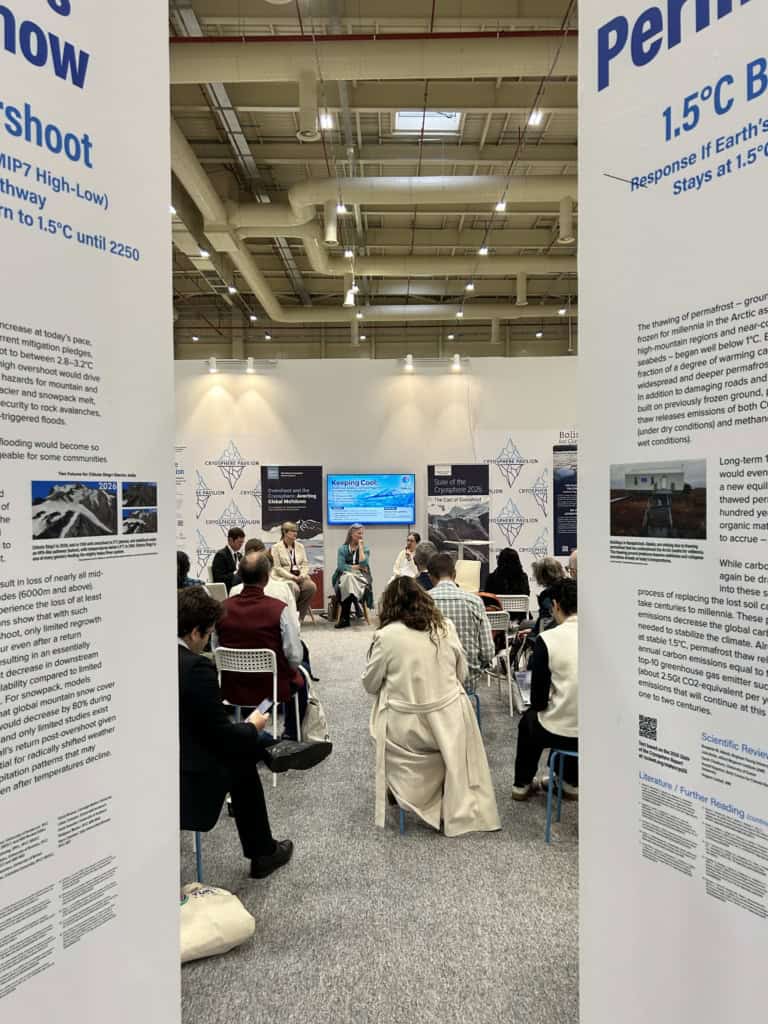
As ministerial talks at COP31 intensified with debates over draft cover texts, fossil fuel language, and climate finance, Brahma Kumaris delegates have continued holding and participating in events within the conference and in the Climate Wisdom Studio. These events have brought together faith leaders, scientists, policymakers, and conservationists to explore ethical leadership and community-driven solutions. From human rights, accessible funding, and Germany’s renewable transition to sustainable yogic agriculture and wildlife protection in Tanzania, these exchanges clearly demonstrate that overcoming political gridlock requires uniting technical and policy innovation with inner resilience, solidarity, and respect for life.
COP31 Interfaith Roundtable Dialogue: Ethical Grounding for Climate Action – Faith, Justice and Shared Responsibility
Blue Zone on 18th November
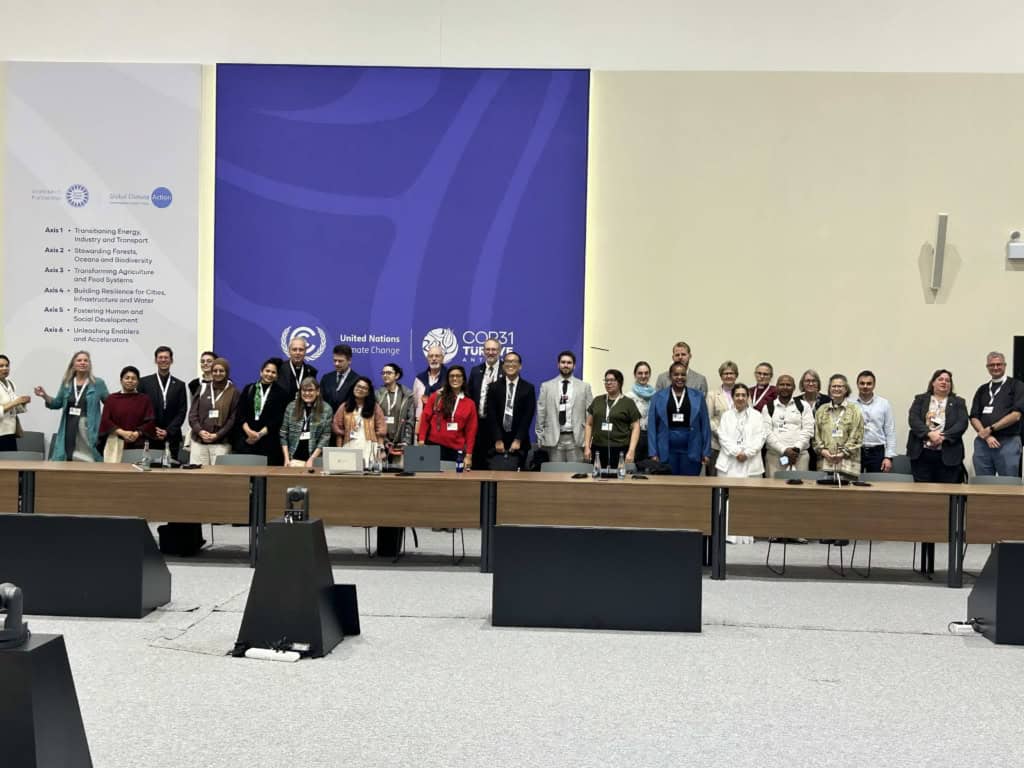
The Interfaith Roundtable Dialogue at COP31 brought together representatives of faith communities, scientific institutions, academia and civil society to explore the ethical foundations of climate action.
Rev. Henrik Grape (moderator), Senior Advisor on Care for Creation, Sustainability and Climate Justice at the World Council of Churches (WCC), opened the dialogue by expressing concern about the slow pace of climate negotiations, growing nationalism and the dominance of short-term economic and geopolitical interests. Recalling the founding principles of the United Nations after the Second World War, he invited participants to reflect on a central question: how can shared ethical and spiritual values inspire greater courage, solidarity and responsibility in addressing the climate crisis?
Rudelmar Bueno de Faria, General Secretary of the ACT Alliance, emphasised that climate change is fundamentally an issue of human dignity, justice and responsibility towards future generations. He called for a just transition away from fossil fuels, climate finance as an obligation rather than charity, and meaningful participation of Indigenous peoples, young people and frontline communities in climate decisions.
Samira Siddique, Director of Strategic Initiatives, Center for Earth Ethics, highlighted the importance of relationships between people, nature and the wider community of life. She stressed the contribution of faith communities in providing spiritual nourishment and addressing climate activism fatigue. She also presented the Global Ethical Stocktake as an initiative to bring ethics, spirituality and values into the UN climate process.
Ramon Pichs-Madruga, Vice-Chair of the IPCC, highlighted the importance of integrating Indigenous, local and practitioners’ knowledge into climate assessments. He encouraged faith-based and community organizations to contribute to the IPCC review process.
Mark Lawrence, Scientific Director at the Research Institute for Sustainability, Potsdam, advocated transdisciplinary cooperation, bringing scientific, spiritual, Indigenous and community knowledge together to develop climate solutions.
Jamie Williams, Senior Policy Advisor, Islamic Relief, outlined practical ways to translate ethical principles into action, including climate justice assessments, participatory decision-making, ethical investment, fossil fuel divestment and ecosystem restoration.
Other speakers highlighted sustainable faith institutions, community resilience, climate education and support for people affected by climate-related disasters, including the importance of addressing non-economic losses such as trauma and displacement.
The dialogue reaffirmed that climate action requires more than technological and financial solutions. It demands ethical leadership, solidarity and sustained cooperation. Its central message was that climate justice is not simply a matter for negotiation; it is a moral obligation that faith communities must translate into concrete action.
COP31 Side Event: Options for a Better World – Choosing More Effective, Healthy and Equitable Climate Policies
Blue Zone on 18th November
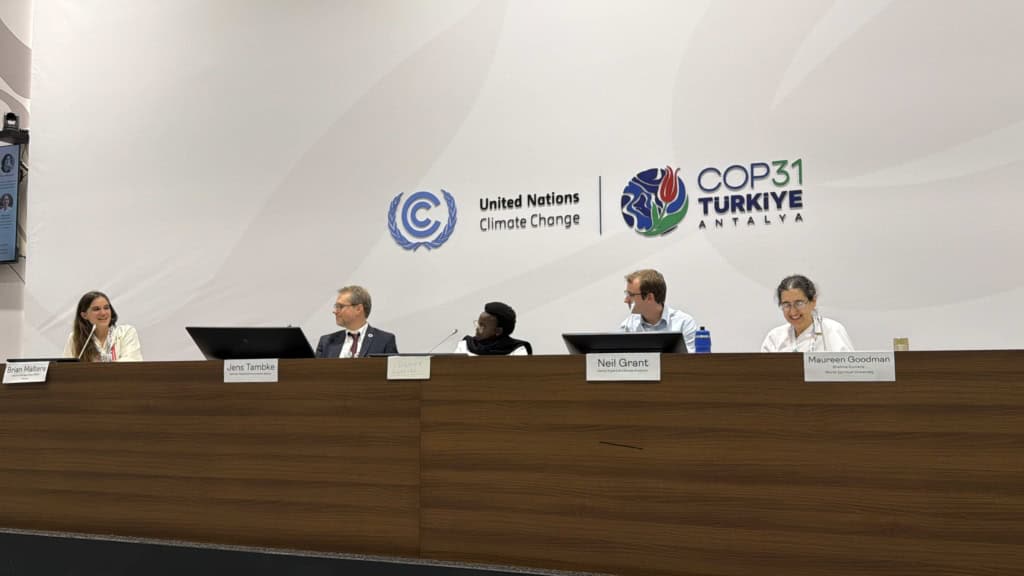
From Left to Right: Flore Ghetti, (moderator) Soka Gakkai International; Jens Tambke, Representative of the German Federal Environment Agency; Denise Ayebare, Founder and Executive Director, BetterLife International; Neil Grant, Senior Expert on Climate Policy Analysis ,Climate Analytics; Maureen Goodman, Programme Director at Brahma Kumaris, UK, and its representative at the United Nations in Vienna; Elisa Morgera, UN Special Rapporteur on Climate Change and Human Rights (not visible)
The COP31 side event brought together experts, civil society representatives, climate advocates and participants from different countries to explore practical climate policies that can deliver positive outcomes for people and the planet.
The event sought to highlight practical approaches that already demonstrate how climate action can advance human and ecosystem health, energy security, social justice and peace.
The central question was how effective, healthy and equitable climate policies could become the norm rather than isolated examples of good practice.
Elisa Morgera, emphasised that states, businesses and financial institutions have responsibilities to respect human rights in addressing climate change. She highlighted community-led solutions developed by Indigenous peoples, small-scale farmers, pastoralists and fishing communities. She called for stronger legal protection, financial support and public policies to support agroecology and locally based food systems.
Jens Tambke discussed Germany’s renewable energy experience, particularly feed-in tariffs that enabled households, farmers and cooperatives to invest in renewable electricity. He stressed that a fair energy transition requires public participation, community ownership and dialogue among governments, businesses, and local communities.
Denise Ayebare described how climate change intensifies interconnected challenges involving food, water, health, education and livelihoods. She highlighted the disproportionate impacts on women and girls and presented communal farming and social enterprises as ways to strengthen community resilience and self-reliance.
Neil Grant outlined how renewable energy, electrification and energy efficiency can replace fossil fuels across major sectors. He emphasised the health benefits of reducing air pollution and the importance of public transport, sustainable diets and equitable access to clean energy.
Maureen Goodman, presented sustainable yogic agriculture, combining organic farming practices with meditation, respect for nature, water conservation and soil restoration. She highlighted its potential benefits for farmers, communities and the environment.
The discussion demonstrated that effective climate action must be rapid, inclusive and grounded in human rights, community participation and a shared responsibility towards people and the planet.
Climate Wisdom Studio on 18th November : Climate Justice, and Ethical Leadership
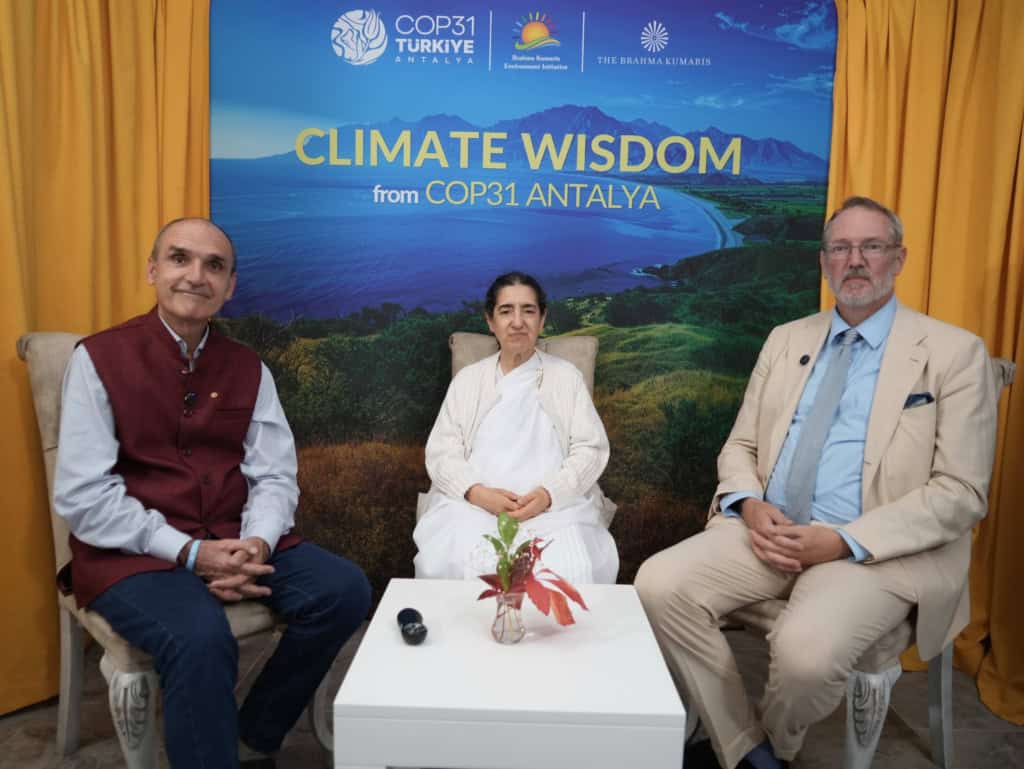
Left to right: Anchor: Golo Pilz, Maureen Goodman, and Simon Chambers.
During this evening’s discussion, Golo Pilz, Adviser Renewable Energy, Brahma Kumaris, interviewed Maureen Goodman, Programme Dir., Brahma Kumaris, UK, and Simon Chambers, Head of Communications Toronto Office, ACT Alliance.
Golo has noticed that during the conference it could be seen that wealthy countries cite domestic debt and inflation as barriers to providing climate grants to meet the demands of vulnerable, developing nations. However, he observed that “climate change is having no borders, it’s affecting everyone”.
Simon said that in relation to climate funds, “We need speed, we need scale and we need access”. Using the glacial flooding in Nepal as an example, he said that often religious groups are the first responders “because they are a part of the fabric of those communities”.
Maureen shared her belief that we can not do this alone, and that we need help from above, daily, through prayer or meditation, so we can build spiritual power. “Am I going to be spiritually strong enough in my connection and in myself to be able to give help?” at a time of need.
Climate Wisdom Studio on 19th November
Episode 1: Wisdom for a World at Crossroads
At the Climate Wisdom Studio. Golo Pilz, Adviser Renewable Energy, Brahma Kumaris, spoke with Dr Vibha Dhawan, Director General of TERI, The Energy and Resources Institute. The discussion was moderated by Sonja Ohlsson, Focal Point to UNFCCC, Brahma Kumaris.
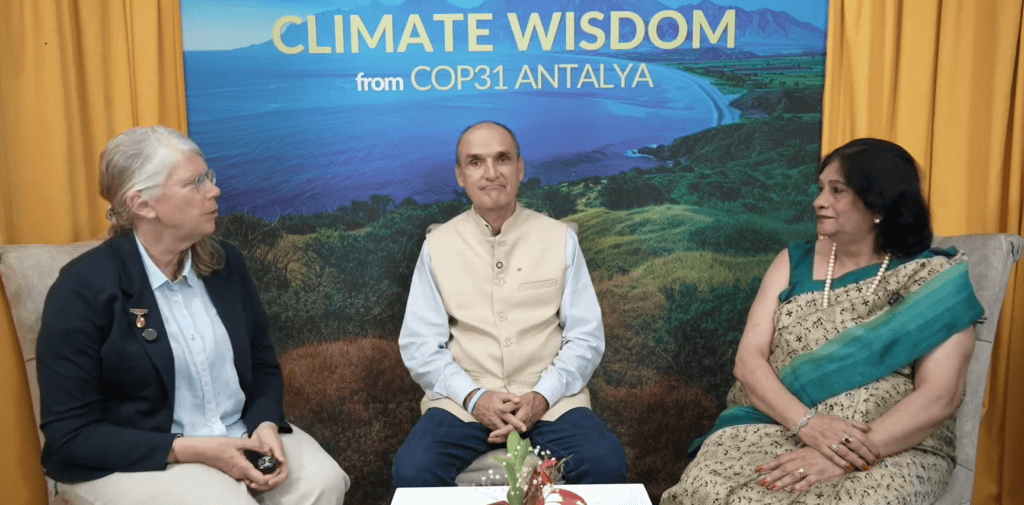
From Left to Right: Sonja Ohlsson, Golo Pilz and Dr Vibha Dhawan
The discussion explored how science, traditional knowledge and human values can support climate action.
Dr Dhawan highlighted the growing impacts of climate change in India, including extreme heat, floods and pressure on agriculture and water supplies. She stressed that developing countries need finance, skilled people and affordable technologies to adapt. Solutions, she said, must be tailored to local circumstances, with collaboration between developing countries playing an important role.
Golo described Brahma Kumaris’ renewable-energy initiatives, including solar power and battery storage at Gyan Sarovar. He also shared examples of sustainable building practices, such as rainwater harvesting, shading and natural ventilation. Reflecting on personal responsibility, he said: “I love myself and I love also the others, the nature and everything. So I take care.”
Both speakers emphasised that implementation remains a challenge. While finance and infrastructure are essential, Golo highlighted education, awareness and individual action. They also noted how traditional practices, including water conservation and tree planting, can complement modern technology.
Episode 2: Nature, Wildlife and Climate Action
Next, Lilian Wawa, Senior Assistant at the Tanzania Wildlife Management Authority, spoke with Golo Pilz. The discussion was moderated by Sonja Ohlsson, Focal Point to UNFCCC, Brahma Kumaris.
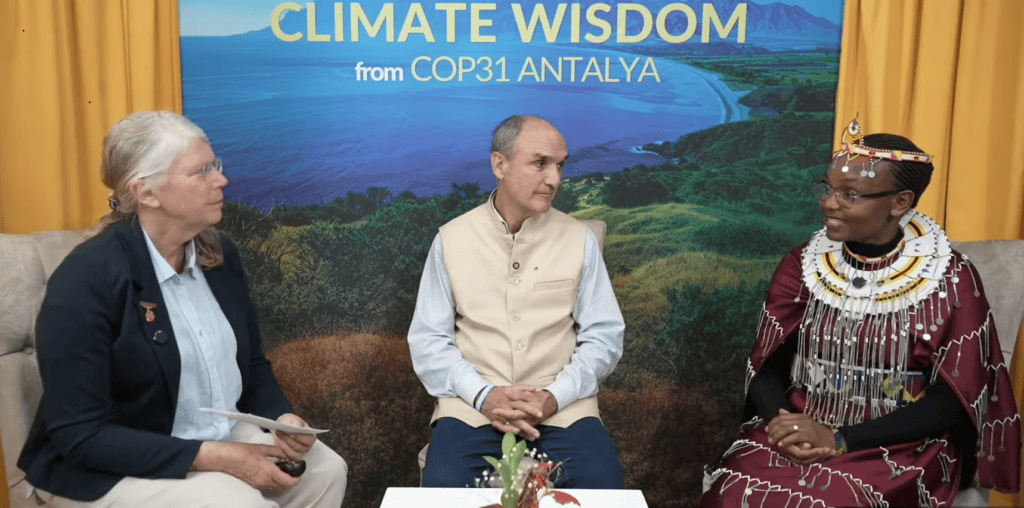
The conversation explored how climate change affects wildlife and the importance of living in harmony with nature.
Wawa explained that prolonged droughts and floods are damaging wildlife habitats and reducing access to water and food in Tanzania, leading to increased human-wildlife conflict and threatening species such as the Puku antelope. She highlighted the importance of community-led conservation, including Wildlife Management Areas that support local livelihoods through tourism and employment. She also called for greater recognition of biodiversity in climate negotiations and climate finance to support wildlife protection. Wildlife, she stressed, should be seen not only as a victim of climate change, but also as part of the solution.
Golo reflected on nature’s interconnected systems and the need to reduce consumption. “We have to go back to natural principles and reduce our energy consumption,” he said. He encouraged long-term thinking, respect for all forms of life, vegetarianism and non-violence.
Related News


1st Service Report Brahma Kumaris at UNCCD COP 15 Abidjan, Cote d’Ivoire (the Ivory Coast)


