
BKs at COP31: Wisdom, Connection, and Mother Earth : Report 4 : 16-17 November
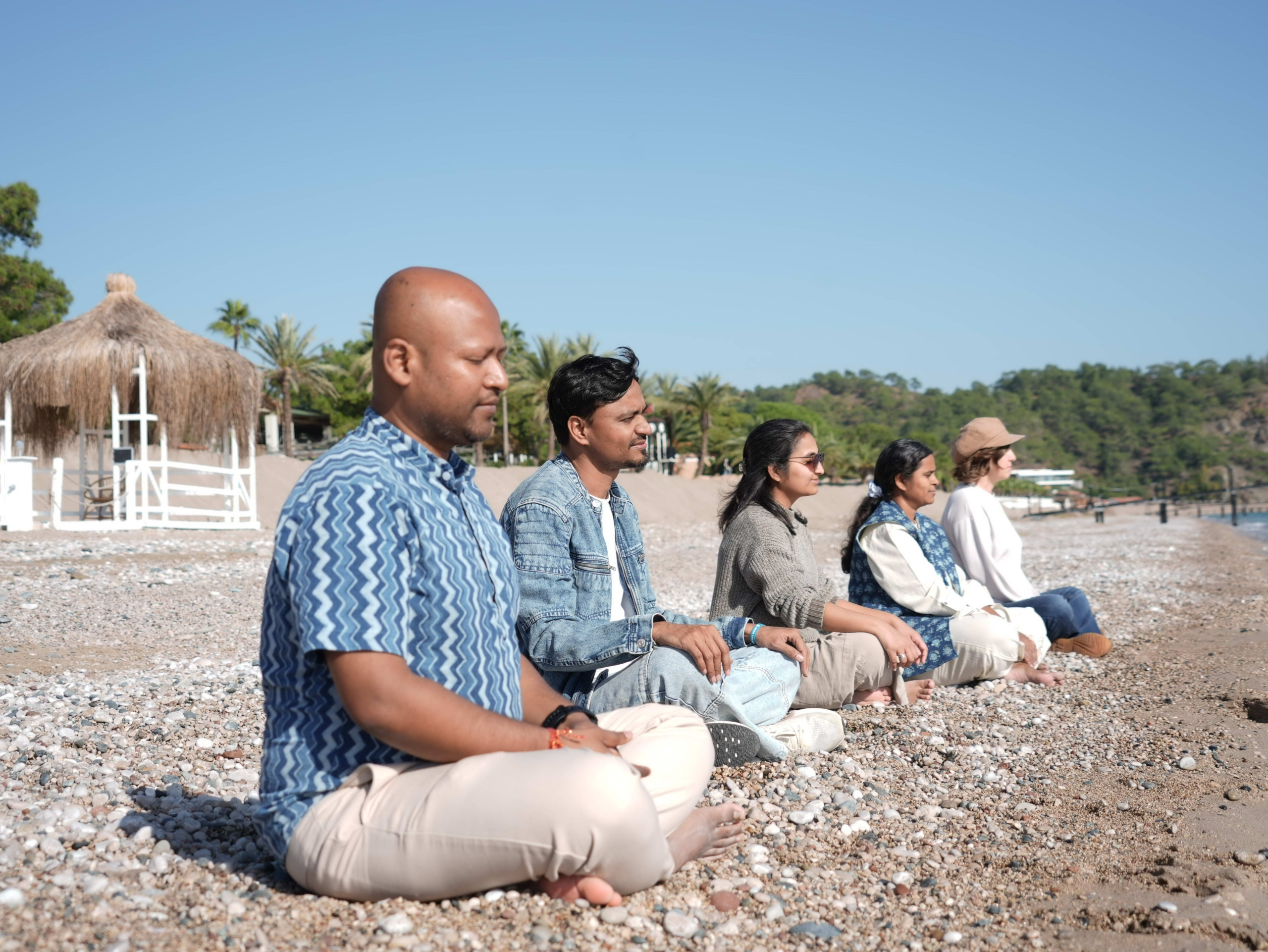
Members of the BK youth team chilling out before the start of week 2 at COP31
Welcome to our latest update from COP31 in Antalya, where spiritual wisdom, human connection, and climate action meet. As the second week of COP31 begins, meet Mother Earth as she makes her presence felt in the Blue Zone by sharing messages of hope and care with delegates. We also bring you key insights from the Climate Wisdom Studio, where our guests have been exploring how ethics, inner resilience, and collective trust can power meaningful progress for our shared home.
Mother Earth made it to COP31…
….Not yet into the negotiation rooms, but into the vast, vibrant, and lively space of the Blue Zone in Antalya.
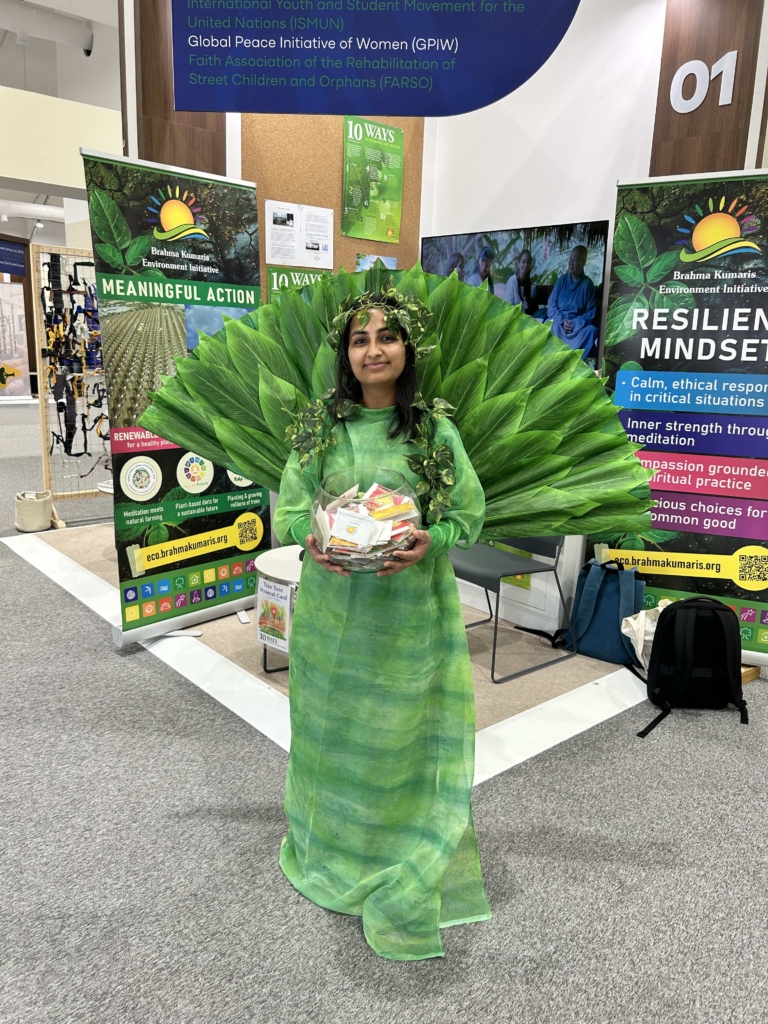
Mother Earth, alias Reena Mehmi from Leicester, sharing affirmation cards
Many delegates came to greet Mother Earth, asking how she was feeling and what she thought about everything happening around her.
She openly shared her feelings and spoke about her current state, which, sadly, is not a very healthy one. Yet, despite all the challenges she faces, Mother Earth never loses the hope and resilience she carries deep in her heart.
And she made sure that everyone who approached her left with a special message – one that brought smiles to their faces, a light to their eyes, and renewed strength to their hearts. Because even when Mother Earth is hurting, she continues to remind us of the beauty of life, the power of hope, and our shared responsibility to care for our only home.
Mother Earth has a message for everyone. Are we ready to listen?
Climate Wisdom Studio on 16th November
Episode 1: Ethics at the Heart of COP31
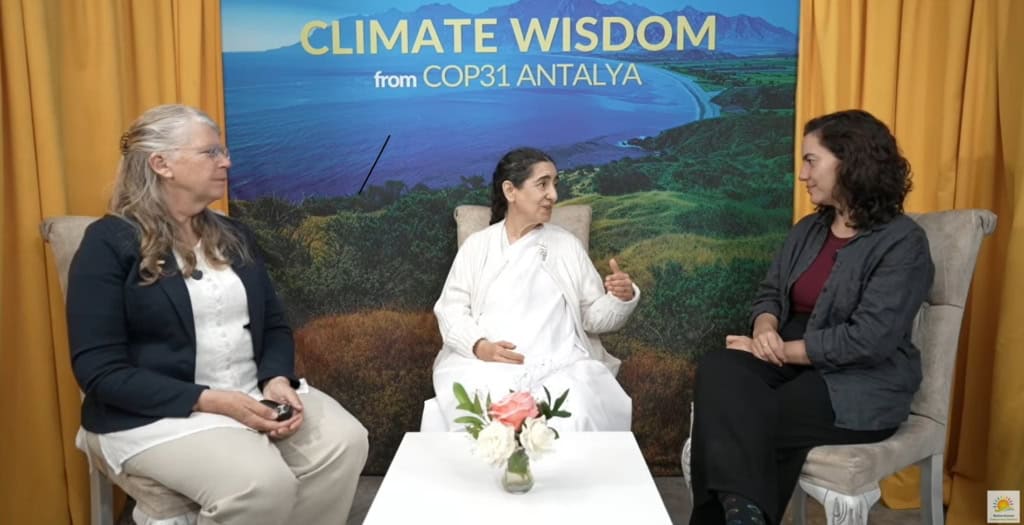
From Left to Right: Sonja Ohlsson (Moderator), Maureen Goodman and Flavia Bellaguardia.
What happens when climate promises meet the test of conscience? Flavia Bellaguardia, Project Manager, COP30 and COP31 Special Advisory Office of the Brazilian Government, and Maureen Goodman, Programme Director, UK, Brahma Kumaris, explored why ethics and spiritual values must underpin climate action.
Flavia highlighted COP30’s recognition of indigenous and rural communities’ knowledge in negotiated texts, an important step towards ensuring their voices influence policy. She also stressed dialogue across geopolitical differences, identifying hope and community as essential to sustaining commitment. “My fuel is hope. I need this to carry on. Community is the key to what gives me hope to keep moving. I’m not doing anything alone; I think it’s impossible to do anything by yourself.”
Maureen emphasised the role of faith communities in promoting stewardship and respect for the Earth, noting how prayer and meditation strengthen the inner values needed for climate action. She highlighted the importance of listening and collective progress: “If you want to go fast, go alone. But if you want to go far, go together.”
Episode 2: Space for Conversation and Connection
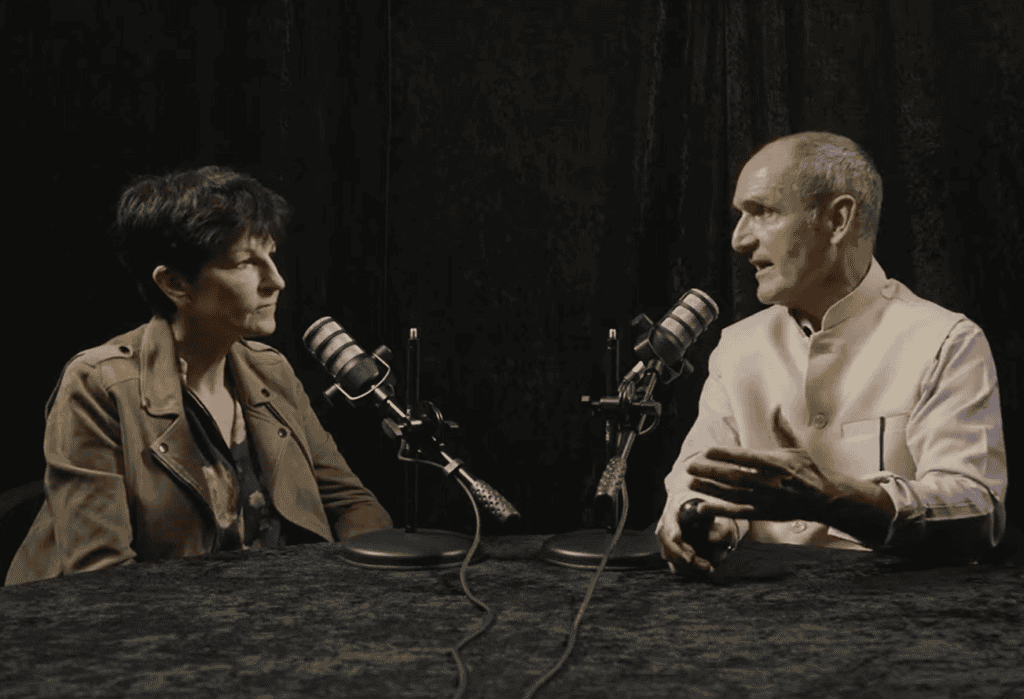
Lindsay Levin, Co-founder of TED Countdown and Golo Pilz, Adviser Renewable Energy, Brahma Kumaris
Lindsay Levin, Co-founder of TED Countdown discussed with Golo Pilz, Renewable Energy Adviser of the Brahma Kumaris, how climate change has connected communities worldwide, inspiring her to bring scientists, policymakers, activists and business leaders together at TED Countdown House.
LIndsay, drawing on 30 years of leadership and transformation experience, emphasised the importance of diverse contributions, from farmers and engineers to entrepreneurs, communicators and community builders. She highlighted a growing desire for face-to-face interaction and trust. As she observed, “When we see the world from another person’s point of view, we’re changed by that.”
Golo brought an inner dimension to the discussion, highlighting how the climate crisis presents an opportunity to transform humanity’s collective mindset and move towards more harmonious living.
Lindsay’s optimism echoed this possibility: humanity’s response to today’s challenges may yet surprise us for the better.
Climate Wisdom Studio on 17th November
From Inner Resilience to Collective Climate Action
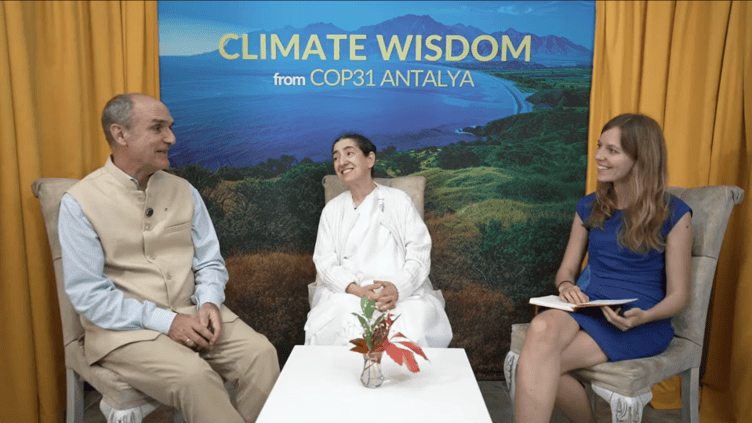
Golo Pilz, Maureen Goodman and Janna Hoppman
This evening, both episodes explored the theme of inner resilience and collective climate action. In Episode 1, Golo Pilz spoke with Ovais Sarmad, Advisor and Vice-Chair of the Greenhouse Gas Protocol Steering Committee and former Deputy Executive Secretary of the UN Climate Change, and Maureen Goodman, Programme Director of the UN in Vienna and UN Representative of the Brahma Kumaris. In Episode 2, Golo Pilz was joined by Janna Hoppmann, Climate and Organisational Psychologist, Social Entrepreneur and Founder and CEO of Climate Mind, and Maureen Goodman.
The conversations focused on inner transformation and effective climate action, prioritising international cooperation, improved climate governance, addressing psychological barriers to action, and building individual, team and institutional resilience, while highlighting meditation, spiritual wisdom, compassion and human connection in climate leadership.
Ovais provided insights into the ongoing COP31 negotiations, viewing current progress as a “glass half full.” While ministers advance political discussions, vital commitments on the 1.5°C limit and transitioning away from fossil fuels remain missing. He called for UN and UNFCCC reforms to improve efficiency and implementation, while urging young people to embrace renewable energy opportunities and hold leaders accountable.
Maureen linked human consciousness to planetary health, explaining that inner qualities like wisdom, benevolence, and dignity positively shape our actions, whereas fear and ego harm nature. Through meditation, silence, and spiritual connection, decision-makers can access inner wisdom. She advocated for “sacred activism” and reminded attendees that “despair is not a strategy,” as spiritual strength sustains hope and resilience.
Janna noted that climate inaction stems from implementation barriers rather than a lack of technology or finance. She highlighted psychology as a vital missing tool in climate governance to build trust, improve decision-making, and foster collaboration. Outlining six pillars of psychological resilience, including social support, self-efficacy, and future orientation, she urged individuals and organisations to move beyond simply recovering to “bouncing forward” and growing through challenges.
Episode 1: Watch here
Episode 2:Watch here
Related News


SB58 Climate Conference 2023 Report 1

